Orthogonal Representational Geometry in dACC Underpins Human Hierarchical Reasoning
On September 1, 2026, Prof. Chen Qi's team from the School of Psychology at Shenzhen University published a research paper entitled "Orthogonal representational geometry in dACC underpins human hierarchical reasoning" in the journal Cell Reports. Combining a novel hierarchical reasoning behavioral paradigm, Bayesian computational modeling, recurrent neural network (RNN) simulation, and functional magnetic resonance imaging (fMRI), this study systematically revealed, at the behavioral, computational, representational, and neural levels, how humans integrate different task information to compute and update confidence in higher-level rule switches during hierarchical reasoning, and accurately infer the source of feedback outcomes to achieve cognitive and behavioral flexibility (Figure 1).
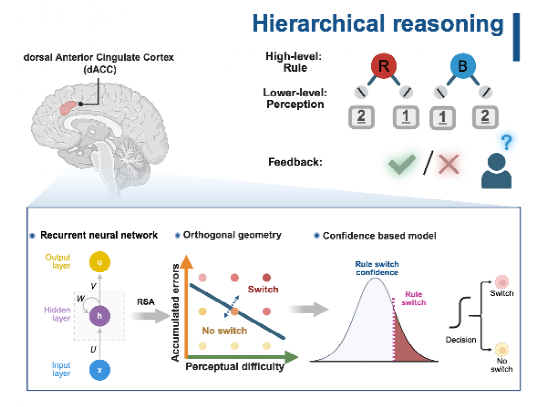
Figure 1. Research framework: Hierarchical reasoning task, recurrent neural network simulation, representational geometry analysis, and Bayesian computational model
Background
In adapting to our environment, we must continuously infer the source of external feedback—especially negative feedback—and adjust our subsequent behavioral strategies accordingly. Tasks in real-world dynamic and uncertain environments often have a hierarchical structure: higher-level stimulus-response rules determine lower-level perceptual judgments. When rules are not known a priori, the cause of negative feedback becomes ambiguous, requiring us to engage in hierarchical reasoning to determine whether an error stems from lower-level perceptual noise or from a higher-level rule choice.
For example, when traveling to a different city, communication difficulties may lead us to wonder whether the problem stems from our own hearing errors or from regional differences in language use. We need hierarchical reasoning to adjust our behavioral strategies and adapt flexibly to the environment. However, how exactly do humans accomplish this hierarchical reasoning process? How does our brain simultaneously maintain different types of information, and how does it combine them to form a judgment about "whether a rule has changed"? The computational and neural representational mechanisms underlying these questions remain unclear.
Methods and Results
To address these questions, this study recruited 29 healthy college students to complete a hierarchical reasoning task during MRI scanning. Upon receiving error feedback, participants needed to infer the source of the error—whether it resulted from a higher-level rule judgment error or a lower-level perceptual judgment error (Figure 1)—so as to flexibly adjust subsequent behavioral choices.
lHumans integrate feedback history and perceptual task difficulty to infer higher-level rule switches during hierarchical reasoning
At the behavioral level, to accurately infer the source of feedback outcomes, individuals need to integrate recent cumulative error history with current perceptual task difficulty information. The more accumulated errors, the more participants tended to believe that the hidden rule had changed; when perceptual judgments were easy and participants were more confident in their judgments, error feedback was also more likely to be attributed to rule switches. Thus, humans can combine "how many consecutive errors" and "how likely it is that I misperceived this time" to infer whether the error comes from perceptual judgment or from a change in higher-level rules (Figure 1).
lHumans update confidence in rule switches according to Bayesian principles during hierarchical reasoning
To reveal the computational mechanism underlying this process, the research team employed a confidence-based Bayesian model (CBM) that integrates the reliability of the current perceptual judgment with the number of previously accumulated errors to dynamically update the posterior probability of a higher-level rule change, i.e., the "rule switch confidence" (Figure 1). Results showed that this model could adequately explain participants' actual rule-switching behavior, suggesting that humans may continuously update their confidence in higher-level rule switches by integrating information from different sources, and adjust behavioral strategies accordingly.
lRecurrent neural network simulation further reveals the representational mechanisms required for hierarchical reasoning
After clarifying "what needs to be computed" for hierarchical reasoning, the research team further asked: in what format should the key information required for hierarchical reasoning be represented, so that it is both distinguishable and amenable to computational integration? The team trained an RNN to simulate participants' rule-switching behavior. Results showed that the RNN not only reproduced participants' behavioral patterns, but its hidden-layer activity encoded accumulated errors and perceptual task difficulty in a manner similar to Gaussian basis functions. More importantly, these two types of information were organized along two nearly orthogonal dimensions. This can be understood as the RNN internally establishing a "representational space" akin to a two-dimensional coordinate system: one dimension primarily represents how many errors have accumulated, while the other primarily represents the reliability of the current perceptual judgment. The orthogonal representational structure can reduce interference between different types of information while facilitating their further integration to efficiently estimate the likelihood of a rule switch.
lHuman dACC exhibits an orthogonal representational geometry similar to RNNs, supporting individuals in completing hierarchical reasoning
At the level of human brain neural activity, the dorsal anterior cingulate cortex (dACC) played a key role during hierarchical reasoning, simultaneously encoding accumulated errors, perceptual task difficulty, and rule switch confidence. Multi-voxel pattern analysis (MVPA) and representational similarity analysis (RSA) further revealed the functional significance of this overlapping encoding: dACC flexibly integrates accumulated errors and perceptual task difficulty using an orthogonal representational geometry similar to that emergent in the RNN hidden layers, to compute and output confidence regarding rule switches (Figure 2). Moreover, this representational structure was closely associated with behavioral performance—the closer the two representational dimensions (errors and difficulty) in dACC were to orthogonality, the better the participants' performance.
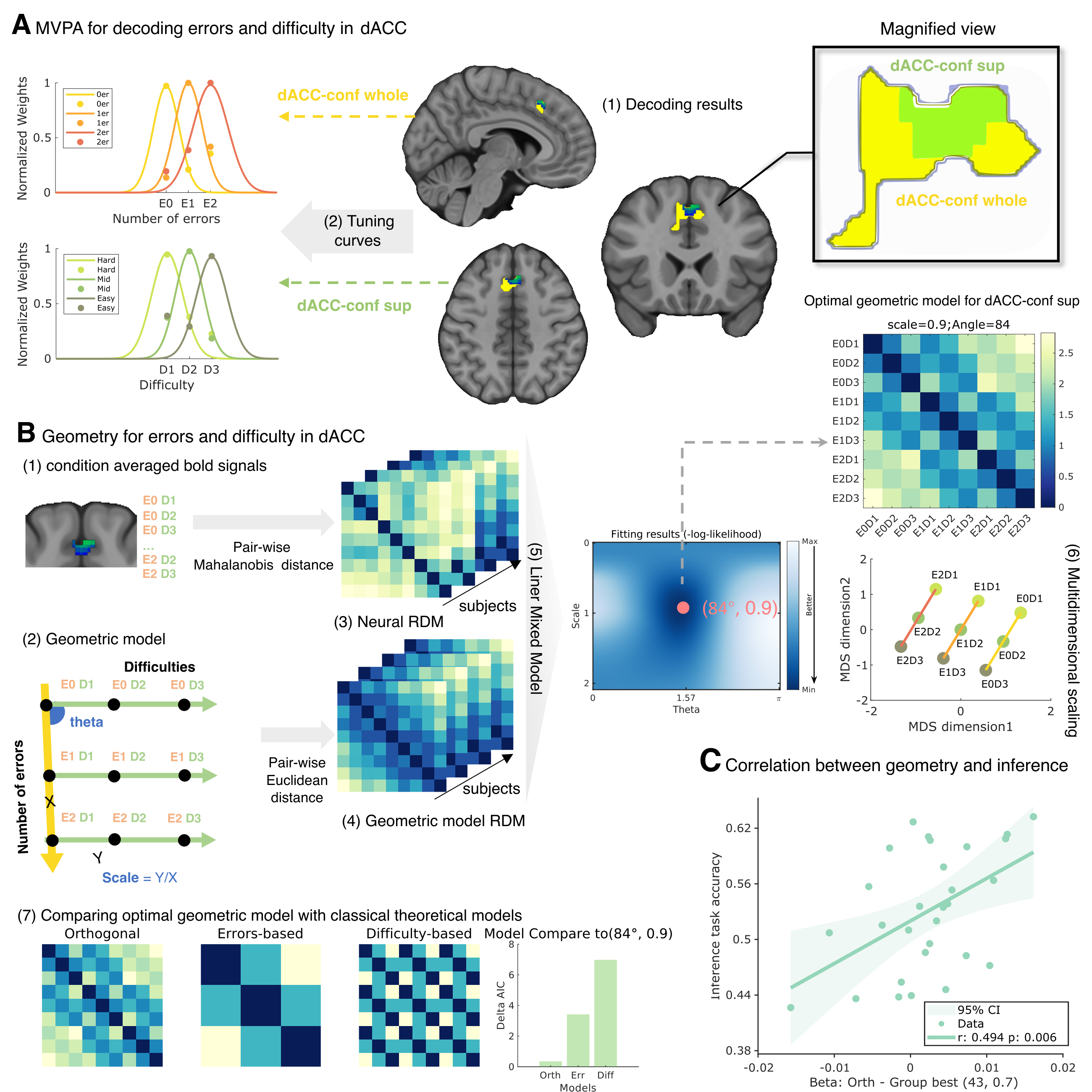
Figure 2. Representational patterns, structure, and behavioral prediction of human dACC supporting hierarchical reasoning
Conclusions
This study systematically investigated the scientific question of how the human brain accomplishes hierarchical reasoning. Computational modeling and representational geometry analysis results indicate that the hierarchical structure of orthogonal representational dimensions within human dACC supports efficient and flexible reasoning. More broadly, this framework also provides new insights for understanding reasoning and other cognitive processes that rely on hierarchical Bayesian inference.
Author Contributions
Prof. Chen Qi from the School of Psychology at Shenzhen University is the corresponding author of this paper, with his PhD student Xu Chuanyong as the first author. Associate Prof. Mei Ning, Dr. Dong Wenshan from South China Normal University, graduated master's student Hu Rongcheng, and Prof. Tom Verguts from Ghent University, Belgium, made important contributions to this study. We thank Assistant Prof. Fan Ying from the School of Psychology at Shenzhen University for her valuable advice on data analysis, and graduated master's student Bai Ruiqi and current master's student Chen Ling for their help in data collection. This research was supported by the National Key R&D Program of China "Brain Science and Brain-Inspired Intelligence" (National Science and Technology Innovation 2030 Major Project) and the National Natural Science Foundation of China.
Paper Information: Xu, C., Mei, N., Dong, W., Hu, R., Verguts, T., & Chen, Q. (2026). Orthogonal representational geometry in dACC underpins human hierarchical reasoning. Cell Reports, 45(9). https://doi.org/10.1016/j.celrep.2026.117929
Research Achievement | Prof. Chen Qi's Team Publishes in Cell Reports