Dr. Jieting Zhang recently collaborated with the Department of Psychiatry, Department of Statistics, and Department of Psychology at McGill University (Canada), the Department of Psychosomatic Medicine at Charité - Universitätsmedizin Berlin (Germany), and the DEPRESSD HADS International Consortium to conduct a large-scale individual participant data meta-analysis (IPDMA) focusing on the scoring methodology of the Hospital Anxiety and Depression Scale (HADS) for screening major depressive disorder.
The research findings were published under the title "Comparison of the accuracy of latent factor and sum scoring of the Hospital Anxiety and Depression Scale to screen for major depression: An individual participant data meta-analysis" in the Journal of Affective Disorders(JCR Q1, 5-year impact factor approximately 6.3), a leading journal in the field of psychiatry and affective disorders.
The paper was completed by Dr. Jieting Zhang (first author), together with collaborators including Professor Brett D. Thombs and Associate Professor Andrea Benedetti from McGill University (co-corresponding authors), Dr. Felix Fischer, and Associate Professor Carl Falk. Dr. Zhang made substantial contributions to the methodological development, study design, and manuscript writing. The College of Psychology at Shenzhen University is the first affiliated institution of this paper.
1.Research Background
The Hospital Anxiety and Depression Scale (HADS) is a widely used screening tool in both clinical practice and research. Its depression subscale (HADS-D, 7 items) and total scale (HADS-T, 14 items) are typically scored using a simple sum score method. However, latent factor models, which weight individual item scores, can theoretically provide more precise estimates of the underlying latent trait. Previous simulation studies have suggested that factor-based scoring may improve screening sensitivity, but empirical evidence based on real patient data remains unclear. This study aims to systematically compare the accuracy of various latent factor scoring approaches for the HADS-D and HADS-T against the classic sum score method in screening for major depressive disorder, thereby providing evidence to guide methodological choices in clinical practice.
2.Research Methods
The study was based on an existing IPDMA database of HADS screening accuracy, including 42 studies that used semi-structured diagnostic interviews (e.g., SCID) as the gold standard for diagnosing major depressive disorder, with a total of 7,982 participants (including 780 cases of major depression). The database was randomly split into a calibration set and a validation set (repeated 1,000 times). In the calibration set, four latent factor models were fitted: a unidimensional model for HADS-D, a unidimensional model for HADS-T, a traditional two-factor model for HADS-T (anxiety and depression-related factors), and a bifactor model for HADS-T (including a general factor and two specific factors). All models included a method effect factor for positively worded items. Factor scores were estimated using Bayesian modal estimation, and the cutoff value was selected as the point maximizing the sum of sensitivity and specificity. In the validation set, the screening accuracy (AUC, sensitivity, specificity) of each factor-scoring method was compared against the HADS-D sum score method, with a difference threshold of 0.05 considered clinically meaningful.
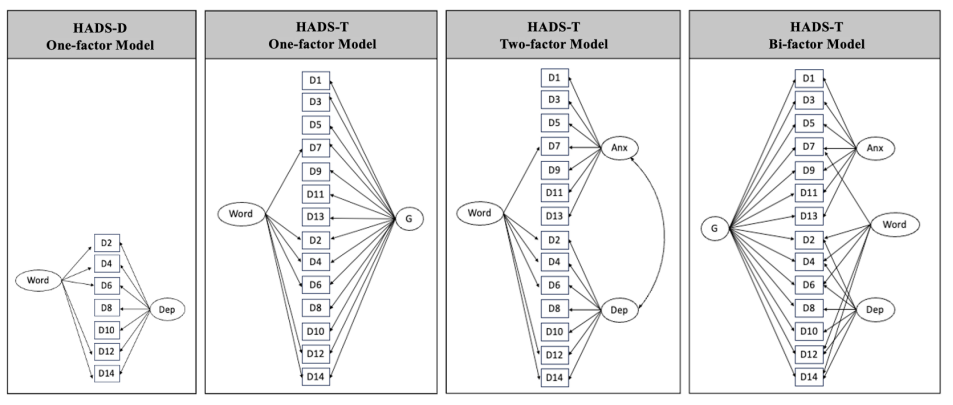
Figure 1. Measurement Model Diagram.G = general factor; Anx = anxiety symptom factor; Dep = depression symptom factor; HADS-D = seven-item Hospital Anxiety and Depression Scale Depression subscale; HADS-T = 14-item Hospital Anxiety and Depression Scale total scale; Word = positive wording factor.
3.Research Findings
The results showed that for all latent factor scoring methods compared with the sum score method, the 95% confidence intervals for the differences in sensitivity, specificity, and the sum of sensitivity and specificity all contained zero, indicating no statistically significant differences. The AUC differences between the two bifactor models and the sum score method were only 0.01–0.02, far below the predefined clinically meaningful threshold. In addition, the complex latent factor models (especially the bifactor models) exhibited a large number of convergence failures or Heywood cases across the 1,000 repeated validations, compromising their practical feasibility. The correlation between the factor scores of these two bifactor models and the sum score was extremely high (r = 0.95–0.97), suggesting that in scales such as the HADS, where item loadings have less variation, factor weighting does not provide additional gains in screening accuracy.
4.Implications and Future Directions
Based on large-scale real-world data, this study found that latent factor scoring methods for the HADS did not demonstrate clinically meaningful advantages over the simple sum score method in screening for major depressive disorder. Given that the sum score method is easy to implement, requires no complex modeling, and achieves comparable accuracy, the study recommends continued use of the HADS-D sum score method in routine clinical and primary care screening settings. Future research could explore whether factor scoring may yield greater value in contexts where item heterogeneity is higher or when combined with multimodal indicators. At the same time, more attention should be paid to the external validity of screening tools, rather than relying solely on structural validity. This study also provides important empirical evidence for the broader psychometric question of whether complex methods outperform simpler ones.
5.Citation
Zhang, J., Fischer, F., Falk, C., Wu, Y., Alkan, A., Sun, Y., Gonzalez-Domínguez, N. P., Boruff, J. T., Cuijpers, P., Gilbody, S., Harel, D., Ioannidis, J. P. A., Levis, B., Markham, S., Patten, S. B., Takwoingi, Y., Ziegelstein, R. C., Benedetti, A., Thombs, B. D., & the DEPRESSD HADS Collaboration. (2026). Comparison of the accuracy of latent factor and sum scoring of the Hospital Anxiety and Depression Scale to screen for major depression: An individual participant data meta-analysis. Journal of Affective Disorders, 412, 122051. https://doi.org/10.1016/j.jad.2026.122051