1.Why Is Psychological Resilience So Important?
Throughout life, each of us encounters various stressful events. Whether stress becomes a source of pathology or a driving force depends on resilience. In the face of stress, challenges, adversity, or trauma, psychological resilience does not simply mean “holding on.” Rather, it encompasses multiple progressively unfolding dimensions: coping, recovery, adaptation, and growth.

A lack of psychological resilience is an important contributor to many psychological problems, while cultivating resilience is a key pathway for preventing mental disorders. Resilience-building is not merely about “repairing after problems arise”; rather, it reflects a preventive and developmental approach to psychological growth.
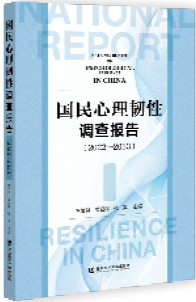
The National Survey Report on Psychological Resilience (2022–2023), edited by Professor Gan Yiqun, Professor Wu Jianhui, and Researcher Zhang Liang and published by Social Sciences Academic Press, is based on nationwide survey data. The report reveals an alarming finding: around the age of 14 represents the lowest point in psychological resilience, and from this stage onward, perceived stress increases rapidly and continues into adulthood.
The 2025 Chinese Character of the Year, “韧” (resilience), precisely captures an urgent need of our time: in a rapidly changing society, resilience is a core capacity that everyone needs to cultivate.

2.From Research to Practice
Psychological resilience is neither innate nor fixed. Rather, it is a dynamic capacity that can be strengthened through training. Like a muscle, it can be developed through scientific methods.
Professor Wu Jianhui has long been committed to scientific research and practical applications in the field of stress and resilience. His latest book, Psychological Resilience: Growing amid Stress and Uncertainty, has been published by China Science and Technology Press. Responding to the needs of our time, the book brings together Professor Wu’s long-standing academic work and deep reflections on psychological resilience, while presenting them in accessible and reader-friendly language.
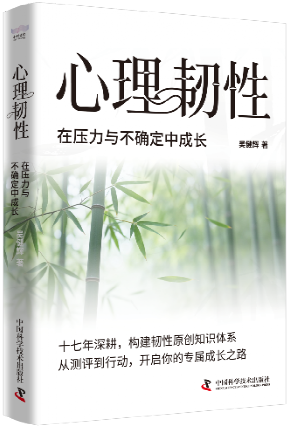
The book is structured around 12 dimensions of psychological resilience. This framework is not a subjective conceptualization, but is grounded in robust evidence-based research, validated through data, and shown to have sound reliability and validity. Based on this multidimensional framework, a corresponding assessment scale has been developed to meet the needs of personalized resilience training. Using this scientific foundation and an online WeChat mini-program, readers can obtain their own resilience profile, accurately identify areas of relative weakness, and engage in personalized reading and training accordingly. Each dimension is organized around four levels—“phenomenon, principle, method, and practice”—helping readers translate understanding into action.
The book and its accompanying digital program provide a scientific pathway for self-help and personal growth for people facing high levels of stress across different fields and professions. They also serve as a valuable reference for psychology teachers and professionals seeking to promote mental health through a preventive approach—addressing potential difficulties before they develop into more serious problems.
During the writing of this book, Professor Wu received support and inspiration from many colleagues and students. Special thanks are extended to Professor Gan Yiqun and doctoral student Wu Xuebing from Peking University, as well as to the students of the Stress and Resilience Laboratory at the School of Psychology, Shenzhen University. Many teachers and students also contributed to polishing the manuscript during the writing process, and their efforts are gratefully acknowledged.