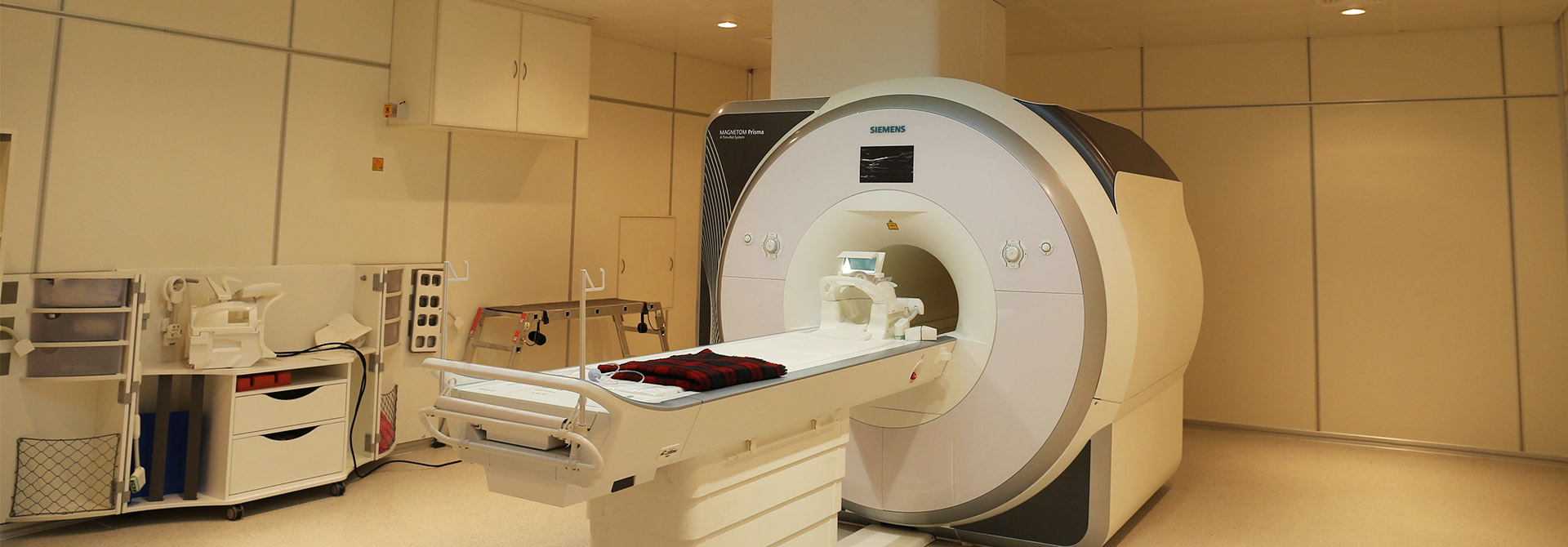
Professor Chen Qi's research group published a paper entitled "Temporal Dynamics of Flexible Cognitive Control" online in the journal NeuroImage. This paper investigates the computational neural mechanism of flexible cognitive control in dynamic environments, and expands the understanding of proactive control and reactive control from the perspective of brain region information flow.
1、Research background
In a dynamic environment, the brain needs to constantly update its expectations of conflict to optimize behavioral performance, and past studies have shown that hierarchical Bayesian models can well account for this control learning process, but there is still a lack of neural evidence on how different brain regions coordinate to implement flexible cognitive control.
2、Research methods
The research team recruited 31 participants who simultaneously recorded behavioral data and EEG activity during the face version STROOP task. The study manipulates the proportion of incongruent trials (80% and 20%) to create a volatile and stable environment, and uses a hierarchical Bayesian model to fit the trial-wise congruency and response time, so as to realize the trial-by-trial inference of the learning rate, prediction conflict and prediction error. We analyze (1) the neural correlation between model variables and oscillations in different frequency bands; (2) directed connectivity patterns between regional neural oscillations associated with model variables; (3) The relationship between directed connection strength reflecting the model variables update with proactive and reactive control.
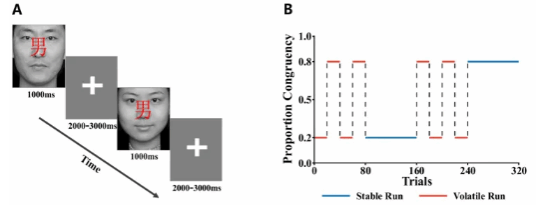
Figure 1: A. Face STROOP task; B. Changes in proportional consistency during experiments
3.Research results
(1)Neural correlation analysis of model variables showed that learning rate, prediction conflict level, and prediction error were correlated with neural oscillations in different frequency bands at different task stages (i.e., stimulus and intertrial stages).
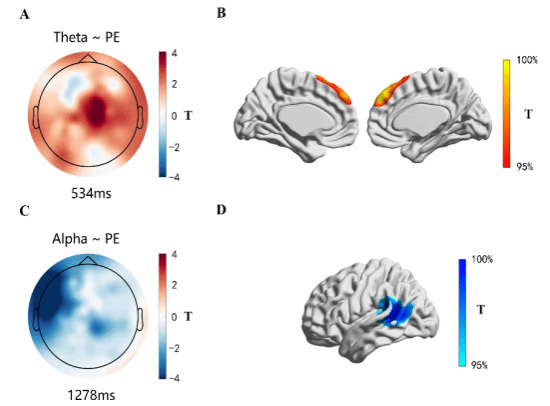
Figure 2: Neural correlation between prediction error (PE) and Theta band (A, B) and alpha band (C, D).
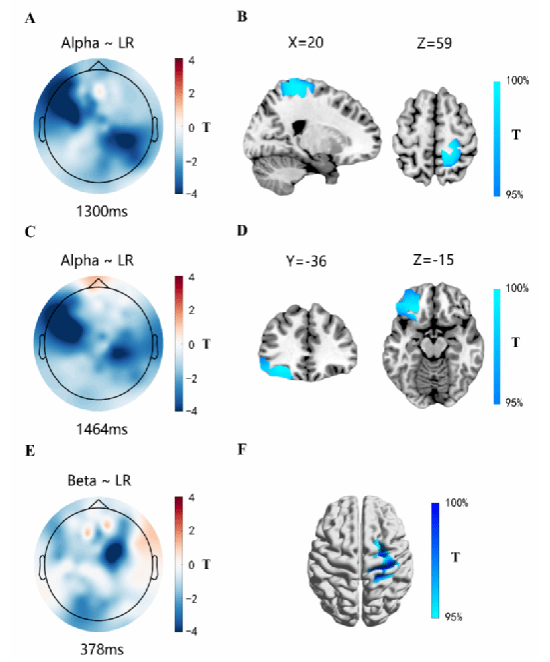
Figure 3: Neural correlation between learning rate (LR) and alpha bands (A, B, C, D) and beta bands (E, F).
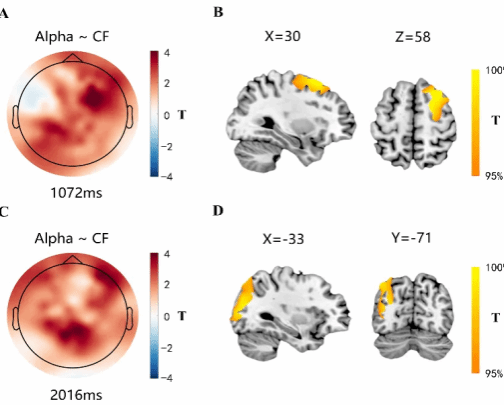
Figure 4: Neural correlation between predicting conflict levels (CF) and alpha bands
(2)Through further Granger causal analysis of these regional neural oscillations related to model variables, it is found that different interregional information flow patterns are found at different task stages.
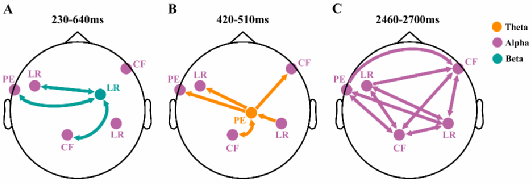
Figure 5: Changes in directed connectivity patterns in the stimulation phase (A, B) and trial interval phase (C) regions
(3) The directed connection strength reflecting the update of learning rate was significantly correlated with reactive control during the stimulus phase; The directed connection strength reflecting the update of the predicted conflict level was significantly correlated with proactive control in the late intertrial stage. This result is consistent with the assumptions of the hierarchical Bayesian model.
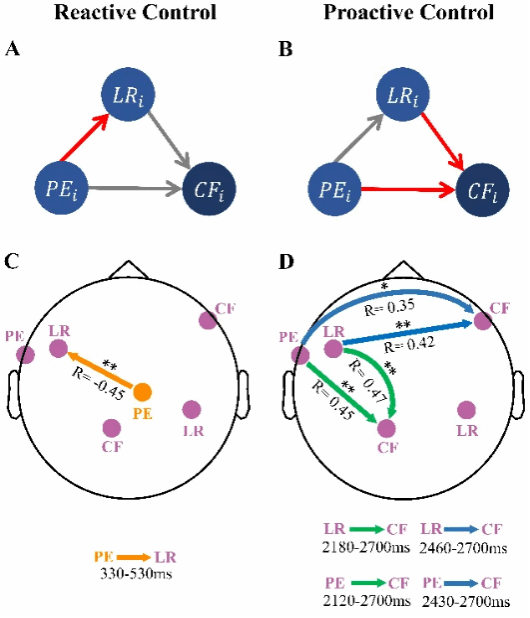
Figure 6: Directed connection strength reflecting model variable updates correlates with active and reactive control
4.Research conclusions
The results of this study first reveal the different neural oscillatory components that support flexible cognitive control, emphasize the role of different neural oscillation components in maintaining cognitive flexibility, and further provide evidence for the temporal dissociation of proactive control and reactive control from the perspective of regional connectivity.
5. Author contribution
Professor Chen Qi of the School of Psychology of Shenzhen University is the corresponding author of the paper, and Wu Chengyuan, a research assistant at the School of Psychology of Shenzhen University, is the first author of the paper. This research was supported by the Science and Technology Innovation 2030 - Major Project (Research on the Neural Circuit Mechanism of Attention-Neural Computational Model of Attention, 2021ZD0203800) and the National Natural Science Foundation of China (32571283).