Recently, the research group led by Associate Professor Xiaojun Cheng at our department published a research paper titled “Spaced instruction for psychological concepts: Insights from interpersonal brain synchronization and students’ perceptions of teaching” in Learning and Instruction, a leading international journal in educational psychology (Top Tier, Chinese Academy of Sciences journal ranking). Adopting the emerging perspective of interpersonal educational neuroscience, this study provides the first systematic evidence that spaced instruction enhances learning outcomes by strengthening teacher–student brain synchronization and improving students’ perceptions of teaching. These findings offer converging evidence across behavioral, neural, and subjective levels, providing a more comprehensive account of why spaced instruction is effective.
1. Research background
A substantial body of research has shown that distributing learning content over time (i.e., the “spacing effect”) is generally more beneficial for knowledge retention than massed or continuous learning. In educational practice, this principle is often reflected in the design of “spaced instruction.” However, existing explanations of the spacing effect have primarily focused on individual cognitive processes (e.g., memory encoding and retrieval difficulty), with limited attention to the inherently social nature of teacher–student interaction.
In fact, teaching is not a one-way transmission of information but a dynamic social interaction process in which teachers and students co-construct knowledge. The unique temporal structure of spaced instruction may facilitate more coordinated interaction and deeper knowledge construction, yet its underlying social-interaction mechanisms remain underexplored.
Recent studies suggest that synchronization of brain activity between teachers and students—referred to as interpersonal brain synchronization (IBS)—indexes shared attention, mutual understanding, and alignment of intentions during instructional interaction, and is closely associated with learning outcomes. Building on this, the present study investigates whether spaced instruction enhances learning by modulating teacher–student IBS and students’ perceptions of teaching, thereby offering novel theoretical insights and empirical evidence for understanding the spacing effect.
2. Research methods
The study adopted a video-based instructional paradigm combined with electroencephalogram (EEG) recording. A total of 61 university students, none of whom were psychology majors, were recruited and randomly assigned to either the spaced instruction group (n = 31) or the massed instruction group (n = 30). Both groups learned the same 10 psychological concepts, with identical total learning time and content; the only difference was the structure of repetition. In the spaced group, sessions on each concept were interleaved with other concepts, whereas in the massed group, two consecutive sessions focused on the same concept. EEG signals were recorded from teachers during video production and from students while they watched the instructional videos. Students completed knowledge assessments before learning, immediately after learning, and one week later, and reported their subjective perceptions of the instructional experience.
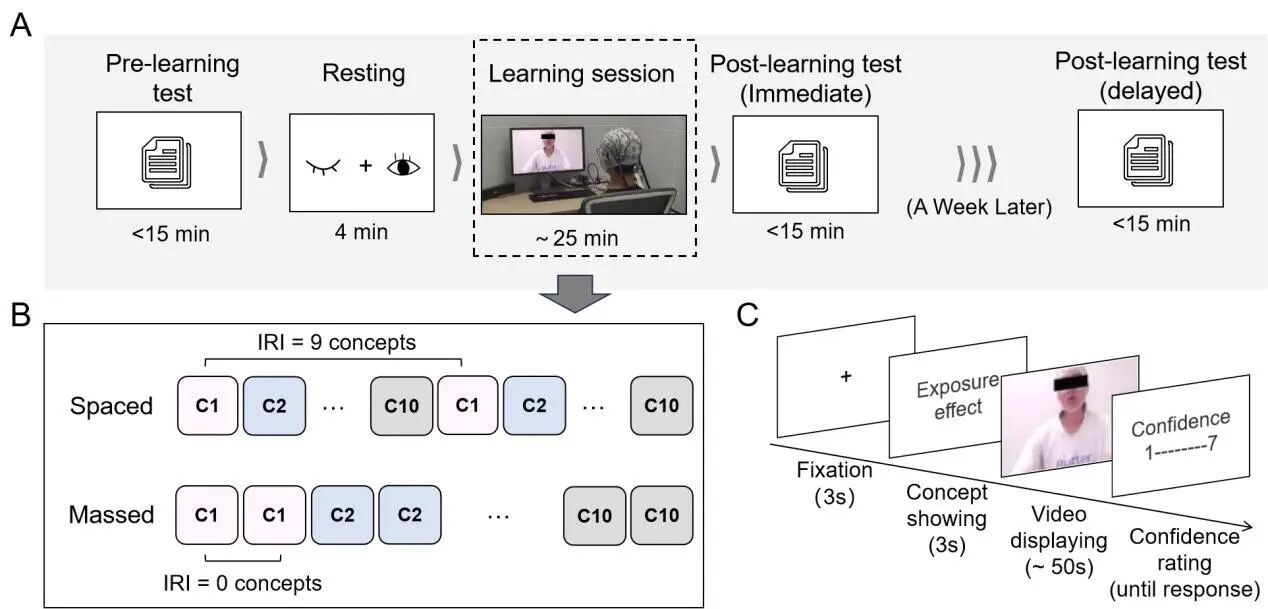
Figure 1. Experimental design. (A) Experimental procedures. (B) The learning sequence of ten concepts for the spaced and massed group. “C1” to “C10” represented the first to tenth concepts. IRI, the inter-repetition interval. (C) Time flow for learning a specific concept.
3. Research results
At the behavioral level, the spaced group significantly outperformed the massed group in both the immediate test and the one-week delayed test, demonstrating the robustness of the spacing effect in concept learning.
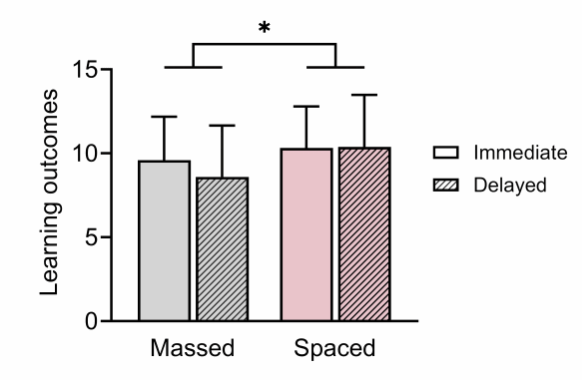
Fig. 2. Behavior results. Compared with the massed group, there was a significant improvement on learning outcomes in the spaced group. *p < 0.05.
At the neural level, the spaced group exhibited stronger teacher–student interpersonal brain synchronization in the prefrontal cortex within the alpha band, indicating enhanced neural alignment during learning.
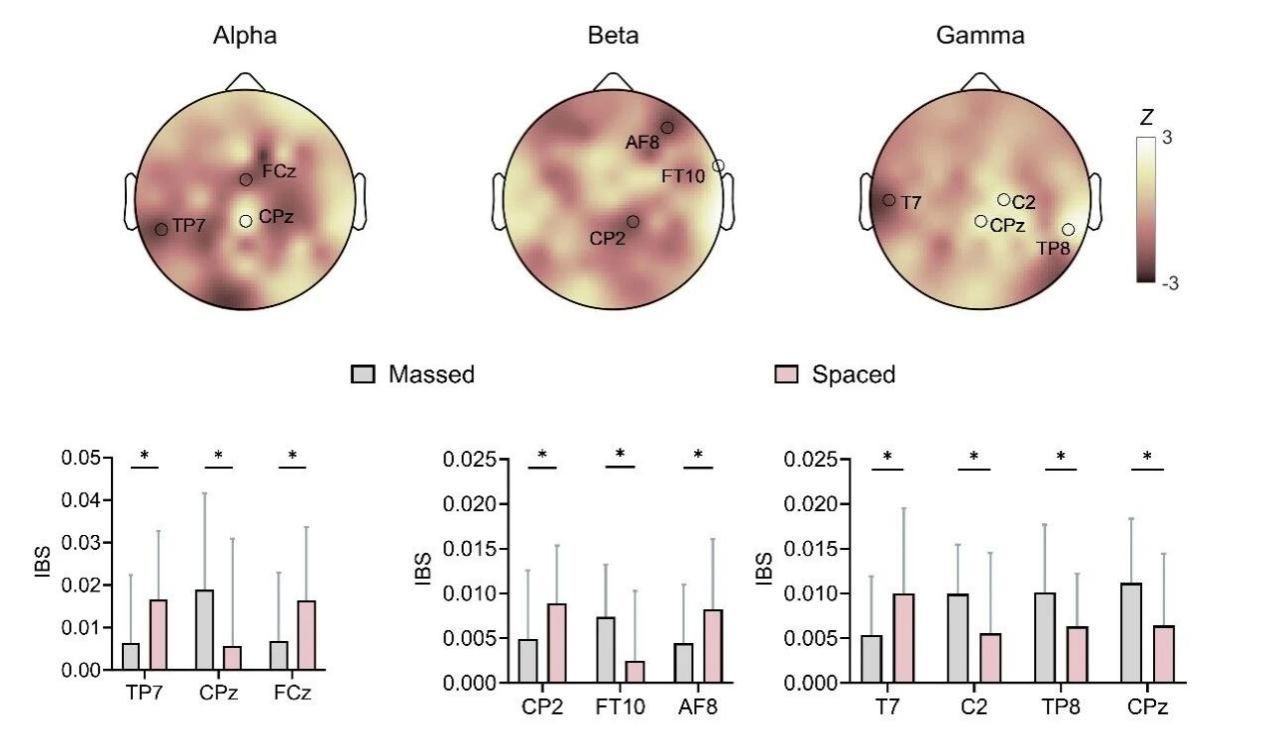
Fig. 3. Teacher–student IBS results. The difference of massed group and spaced group on teacher–student IBS. *p < 0.05.
Furthermore, within the spaced group, teacher–student IBS was positively correlated with students’ positive evaluations of teaching, and these evaluations partially mediated the relationship between IBS and learning outcomes. These findings suggest that spaced instruction may enhance learning through a dual pathway: increasing neural synchronization and improving students’ subjective learning experiences.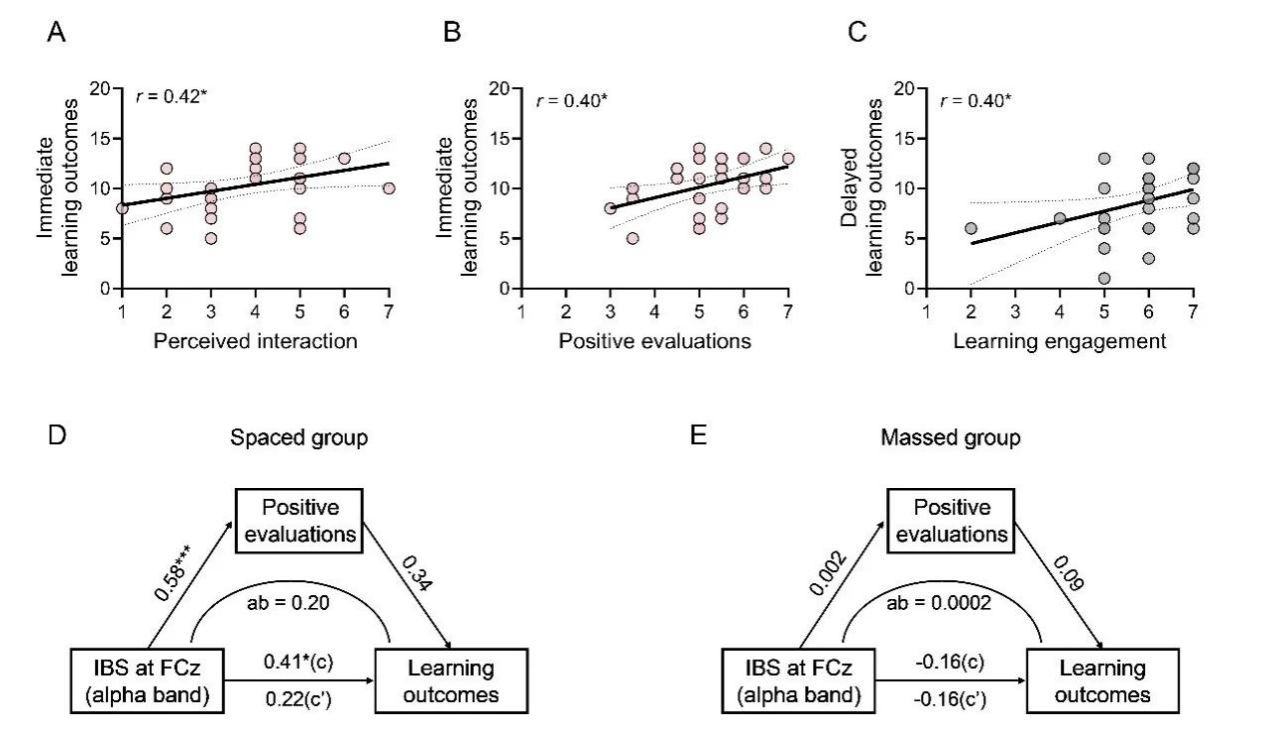
Fig. 4. The association between IBS, perceptions of teaching and learning outcomes. (A) The perceived teacher–student interaction and (B) positive evaluations of teaching in spaced group are positively correlated with the immediate learning outcomes, and (C) learning engagement shows positive association with delayed learning outcomes in massed group. (D) The relationship between IBS and immediate learning outcomes may be mediated by positive evaluations in the spaced group, (E) but this mediation does not hold in the massed group. *p < 0.05.
4. Research conclusions
By integrating behavioral assessments, EEG data, and subjective reports, this study provides the first systematic psycho-neural account of spaced instruction from an interpersonal neuroscience perspective. The findings demonstrate that spaced instruction not only improves learning outcomes but also optimizes teacher–student neural alignment and enhances students’ perceptions of teaching, forming a coordinated “neural–psychological–behavioral” pathway. These results offer important implications for instructional design, highlighting that effective teaching should not only consider how content is sequenced, but also how teacher–student interaction is structured and supported over time.
5. Author contribution
This study was conducted at the School of Psychology, Shenzhen University, and the School of Psychology, Shanghai Normal University. Associate Professor Xiaojun Cheng from Shenzhen University is the first author, and Dr. Yinying Hu from Shanghai Normal University is the corresponding author. Co-authors include Wenyuan Liao and Haichan Cui from Shenzhen University, as well as Dr. Yafeng Pan from Zhejiang University. This work was supported by the Humanities and Social Sciences Research Project from the Ministry of Education of China, the Shenzhen Science and Technology Program, and other funding sources.
6. References
Cheng, X., Liao, W., Cui, H., Pan, Y., & Hu, Y. (2026). Spaced instruction for psychological concepts: Insights from interpersonal brain synchronization and students’ perceptions of teaching. Learning and Instruction, 102, 102320. https://doi.org/10.1016/j.learninstruc.2026.102320